
Summit County Most Wanted Status
The Summit County Sheriff's Office keeps no standing most-wanted page and no public fugitive list. That absence matters. Without one, no honest count, weekly update day, or photo policy can be claimed. No set of people can be presented as the county's most wanted. The Sheriff's weekly Justice Files sometimes mentions a warrant arrest. It usually leaves out names, though, and is not a wanted-person database. County finance documents labeled "warrant list" are just payment registers, not arrest warrants.
So there is no official browseable gallery. Someone with first-hand information can use the Sheriff's anonymous tip form. Someone tracking a court matter can search the Colorado docket and call Summit Combined Courts for help with case records. Neither route is a complete active-warrant database. A docket shows scheduled court activity. A warrant, by contrast, is a command from a court or law-enforcement agency that only the responsible office can confirm.
Wanted information also shifts quickly. An arrest, a court appearance, or a recall can change it. A copied notice loses its context fast. And do not lean on another state's Summit County page. Colorado, Ohio, and Utah all have counties by that name. Their sheriff tools say nothing about arrests or warrants in Breckenridge, Silverthorne, Frisco, or unincorporated Summit County, Colorado.
Note: A documented absence of a list beats filling the gap with an unofficial gallery or another state's records.
Summit County Wanted Listing Fields
Summit County does not publish a wanted list. So no field inventory can be presented as if it did. The table below keeps the fields readers usually expect while showing what local official sources actually provide. That approach keeps an empty field from turning into a guessed fact. It also makes the proper verification route plain.
| Expected listing field | Summit County status | Official alternative |
|---|---|---|
| Name | No standing public list was found | Use a known case or party name in the Colorado docket search |
| Booking or wanted photo | No official wanted gallery was found | Booking photographs are requested from Sheriff Records when legally releasable |
| Warrant basis or charge | No public county warrant portal was found | Confirm filed case information with Summit Combined Courts |
| Physical description | No local listing schema exists to supply it | Give observed details directly to law enforcement when reporting a tip |
| Last known area | Not published through a standing list | Report current, first-hand location information through the official tip channel |
| Caution flag or reward | No list, reward amount, or Crime Stoppers program was verified | Never approach; call 911 only for an immediate danger |
A missing field does not mean no warrant exists. It only means the county does not expose that detail through any verified public most-wanted list. Court staff and sheriff staff each control different parts of a warrant record. Route your question to whichever office issued it or acts on it.
Use Summit County Wanted Channels
Browsing a wanted page would normally mean comparing official photos and listing details. Summit County has no such page. So the safe process starts with why you are searching. Tips about another person go to law enforcement. Questions about your own status go to counsel and the court. For a known booking, follow the county records path described on the Summit County busted mugshots home page.
- Confirm the jurisdiction. Make sure the matter concerns Summit County, Colorado, rather than a same-named county in Ohio or Utah.
- Do not search for a gallery. The Summit County Sheriff's site has no verified standing wanted list, so do not treat an unofficial face page as the county list.
- Choose the correct official route. Send first-hand information through the anonymous tip form. Use the Colorado Judicial Branch for known case and docket information.
- Read the source's limits. A docket is schedule-level data and may omit protected, suppressed, or juvenile matters. It is not a complete warrant index.
- Verify the current status. Ask the issuing court or an attorney to interpret current case action. A prior mention of a warrant may no longer reflect the live record.
- Act safely. Never approach, follow, confront, or try to detain someone. Call 911 when there is an immediate threat.
The official anonymous Sheriff tip form is the proper web channel for public information. The capture below shows the form itself, not a list of people or rehosted booking photos.
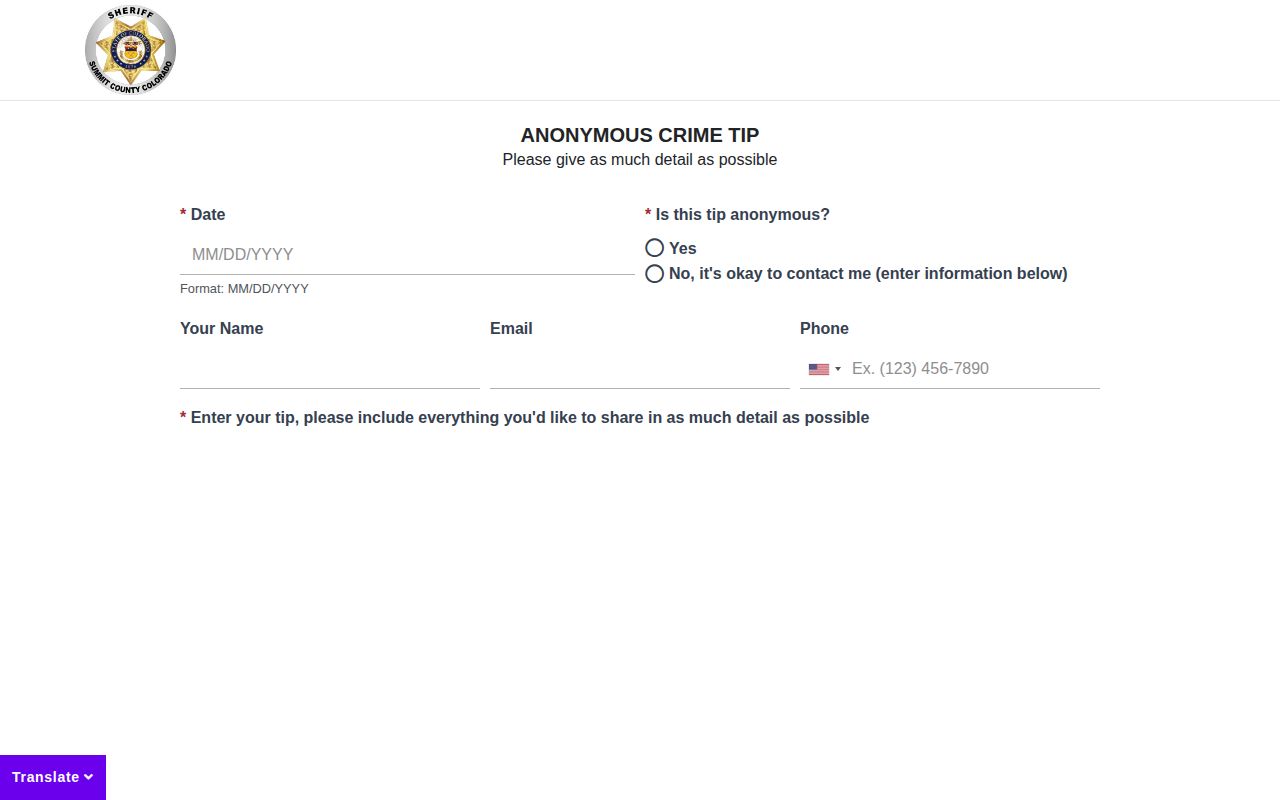
Use that form for solid, good-faith facts. It is not a place to seek confirmation of a warrant or to accuse someone on rumor.
Check Summit County Warrants Safely
Summit County has no official public arrest-warrant search portal. There is no verified warrants-unit phone line either. The Colorado Judicial Branch docket search can help you find a known Summit County case. It does not promise a full list of active warrants, though. Summit Combined Courts can assist with court records. The Sheriff's general or nonemergency contacts can route a law-enforcement question. Neither office guarantees telephone confirmation in every case.
- Gather exact case facts. Use the full legal name and, if known, a case number or court date. Avoid drawing conclusions from a partial name match.
- Search the state docket. Select the Summit County or Fifth Judicial District filters and add the required party, case, attorney, courthouse, or other criterion.
- Separate schedule from status. A docket can show events and dates, but it is not itself a certified active-warrant response.
- Contact the court. Ask Summit Combined Courts what case record can be provided and how to obtain the register of action or filed orders.
- Resolve personal concerns through counsel. A lawyer and the issuing court can address appearance, surrender, recall, bond, or other lawful next steps without offering advice to avoid service.
The official Colorado docket search lets you filter by county, courthouse, date, party, case, or attorney, and it requires at least one filter besides date. The captured search interface below shows why a narrow, case-based query differs from browsing a county wanted list.
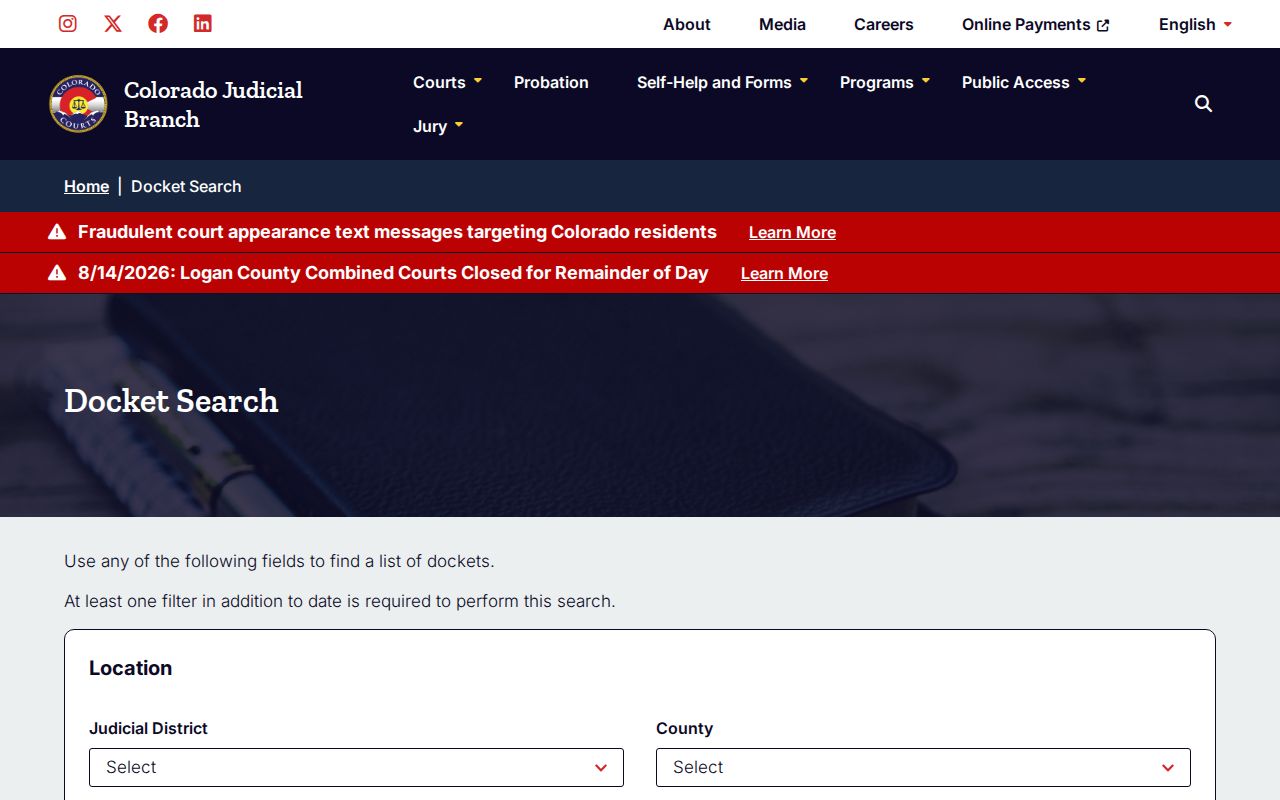
For a complaint, register of action, disposition, sentence order, or other filed document, use the court's electronic record-request route. Protected or suppressed records may stay unavailable.
Summit County Warrant Types
Warrant names usually describe why a court issued the warrant or which court controls the file. They say nothing about whether it is still active. The practical advice holds for every category. Find the issuing case. Confirm the current record with the responsible court. Get legal advice if the warrant might involve you.
| Warrant term | What it generally signals | Safe Summit County check |
|---|---|---|
| Arrest warrant | A court-authorized arrest tied to an alleged offense or filed matter | Trace the issuing criminal case through Summit Combined Courts and counsel |
| Bench warrant | A court order that may follow a missed required appearance or other court directive | Check the docket, then ask the issuing court about current orders |
| Municipal warrant | A warrant connected with a town-level case rather than a county or district filing | Contact the named municipal court; do not assume the county docket is complete |
| Out-of-county warrant | An order controlled by another Colorado or out-of-state court | Verify with that issuing jurisdiction, even if an arrest occurred in Summit County |
These are routing terms, not a list of Summit County cases. A booked person may have been held on a warrant, new allegations, or both. Booking allegations can later be changed, declined, or dismissed, and the court disposition is the reliable endpoint.
Note: Court records identify judicial action; the Sheriff's records document arrest and booking activity. One source does not replace the other.
Summit County Wanted Tips
Want to report someone on a Summit County warrant list? The Sheriff's Office keeps an anonymous online form for that. Use it. There is no verified local Crime Stoppers reward program here. No published reward amount exists either. You also won't find a regular "Warrant Wednesday" feature, so don't count on a payout. Trust only what the official form promises. The strongest tips come from firsthand knowledge and enough detail that deputies can act on them. A rumor, a lookalike spotted on social media, or an old arrest photo just isn't solid ground to point a finger at anyone.
Summit County Sheriff's Office501 N. Park Ave., P.O. Box 210
Breckenridge, CO 80424-0210
Office: 970-453-2232
Nonemergency dispatch: 970-668-8600
Online: Anonymous tip form
Immediate danger: 911
Tips and warrant checks are two different errands. Fill out the Sheriff's form and you're sending information in; you won't get a list of active warrants back. Think you might have a warrant yourself? Call a lawyer and the court that issued it. If there's an immediate danger, dial 911 and do what the dispatcher tells you.
Summit County Wanted Alerts
Colorado's Summit County has no sheriff mobile app. There's no official "Warrant Wednesday" and no routine most-wanted feature either. Be careful here. Apps bearing similar names belong to Summit County in Ohio or Utah. Neither one can check a Colorado warrant or take a Colorado tip. For public-safety updates, the Sheriff's Facebook, Instagram, and YouTube pages carry news, though none of them runs a standing most-wanted feed.
Other county alert systems fill different roles. VINE notifies you about custody or case changes tied to a specific person. SC Alert handles wider emergency and community warnings. Neither one works as a warrant search or booking-photo gallery. Tips still go through the anonymous Sheriff form. Personal warrant questions go through a lawyer and the issuing court.
Note: A post or alert may be timely, but only the responsible court and agency can confirm the current warrant record.
Summit County Wanted Case Outcomes
A wanted notice or arrest kicks off a legal process. It never ends one. The typical path runs from a prosecutor's filing decision to a first appearance, then bond arguments, and finally hearings, a plea deal, or a trial. The finish line is what courts call the disposition. That just means the recorded outcome. It can look very different from the initial claim, with charges reduced, dropped, or resolved on entirely different terms.
Summit County sits inside Colorado's Fifth Judicial District. Its official court page offers courthouse contacts, docket access, and an electronic way to request documents. Dockets work well for schedules. For deeper case history, try a register of action or a disposition order. Some limits still apply, though. Juvenile, probate, or sealed files stay off limits to the public.
Getting picked up on a warrant usually means a booking at the Summit County Detention Facility. Walking out of county custody does not close the case. If a judge later imposes a prison term, custody records move over to the Colorado Department of Corrections inmate locator. Each source answers a separate question. None of them works as a single running list of wanted people.
Names can deceive. Before repeating anything about a wanted person, check the identity, the jurisdiction, and the newest court result, since a shared name can point to someone with no connection at all.